
Most business owners think of their windows as something to look through. The businesses with the strongest street presence have learned to think of them as something to look at.
Window graphics are one of the most underutilized tools in local business marketing. They’re visible to every person who walks or drives past, they work around the clock without recurring cost, and they don’t require anyone to click, scroll, or opt in to see them. They’re simply there — doing their job every time the lights are on.
This guide covers the main types of window graphics, what each one does best, and how to make the right choice for your space and goals.
Why Window Graphics Work
Before getting into specifics, it’s worth understanding why window graphics perform as well as they do for local businesses.
A storefront window is some of the most valuable real estate a business has — it faces the street, it’s at eye level, and it captures the attention of anyone passing by without requiring any active effort on their part. The difference between a business with well-designed window graphics and one with bare glass is immediately visible, and it signals something important to potential customers: that this business is professional, established, and invested in its presentation.
For businesses in competitive markets — retail, food service, professional services, health and wellness — that first impression can determine whether a first-time visitor walks through the door or keeps walking. For businesses in less foot-traffic-dependent markets, window graphics communicate hours, services, and branding to drive-by traffic that may never slow down long enough to read a website.
In both cases, the window is doing marketing work that would otherwise require paid advertising to replicate — and unlike paid advertising, a window graphic doesn’t stop working when the budget runs out.
Types of Window Graphics: What Each One Does
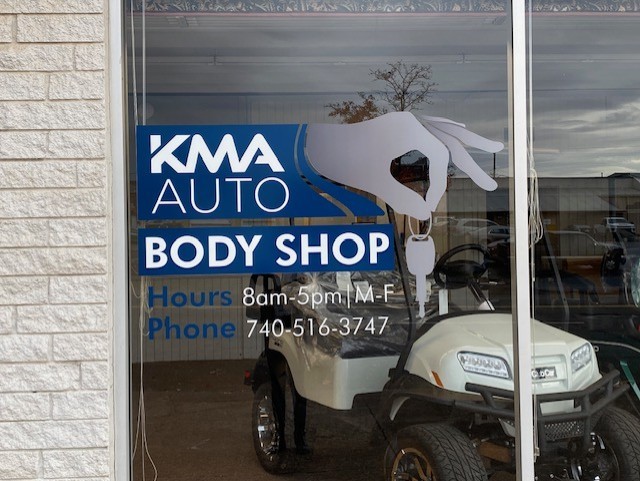
Window decals and cut vinyl lettering
The most straightforward window graphic application. Cut vinyl lettering applies directly to the glass — business name, hours, phone number, website, tagline, service list. It’s clean, durable, and reads clearly from a distance.
Cut vinyl is applied in single colors and works best for text and simple shapes. It’s the right choice when the goal is clear, legible information rather than a full visual design. For businesses that want to display their name and hours prominently on the door or front window without committing to a full design treatment, cut vinyl is the most cost-effective starting point.
Lifespan on properly cleaned glass in a standard environment is five to seven years. It can be removed cleanly when needed, making it a good option for businesses in leased spaces where permanent changes aren’t possible.
Full-color window graphics and printed vinyl
When the goal is a full visual — a branded design, a promotional graphic, a product image, a seasonal campaign — printed vinyl is the right material. Full-color window graphics are produced on a wide-format printer, laminated for durability, and applied directly to the glass or to a clear substrate that adheres to the window.
These graphics can cover a portion of the window or the entire glass surface, depending on the design intent and how much natural light needs to pass through. They’re particularly effective for retail businesses that want to use their windows as display space — turning what would otherwise be a view into the store into a brand statement visible from the street.
Full-color window graphics are also the standard approach for promotional campaigns. A seasonal sale, a new product launch, a grand opening — any time the message is temporary but the visual needs to be high-quality, printed window vinyl delivers that combination at a cost that makes sense for short-term use.
Perforated window vinyl
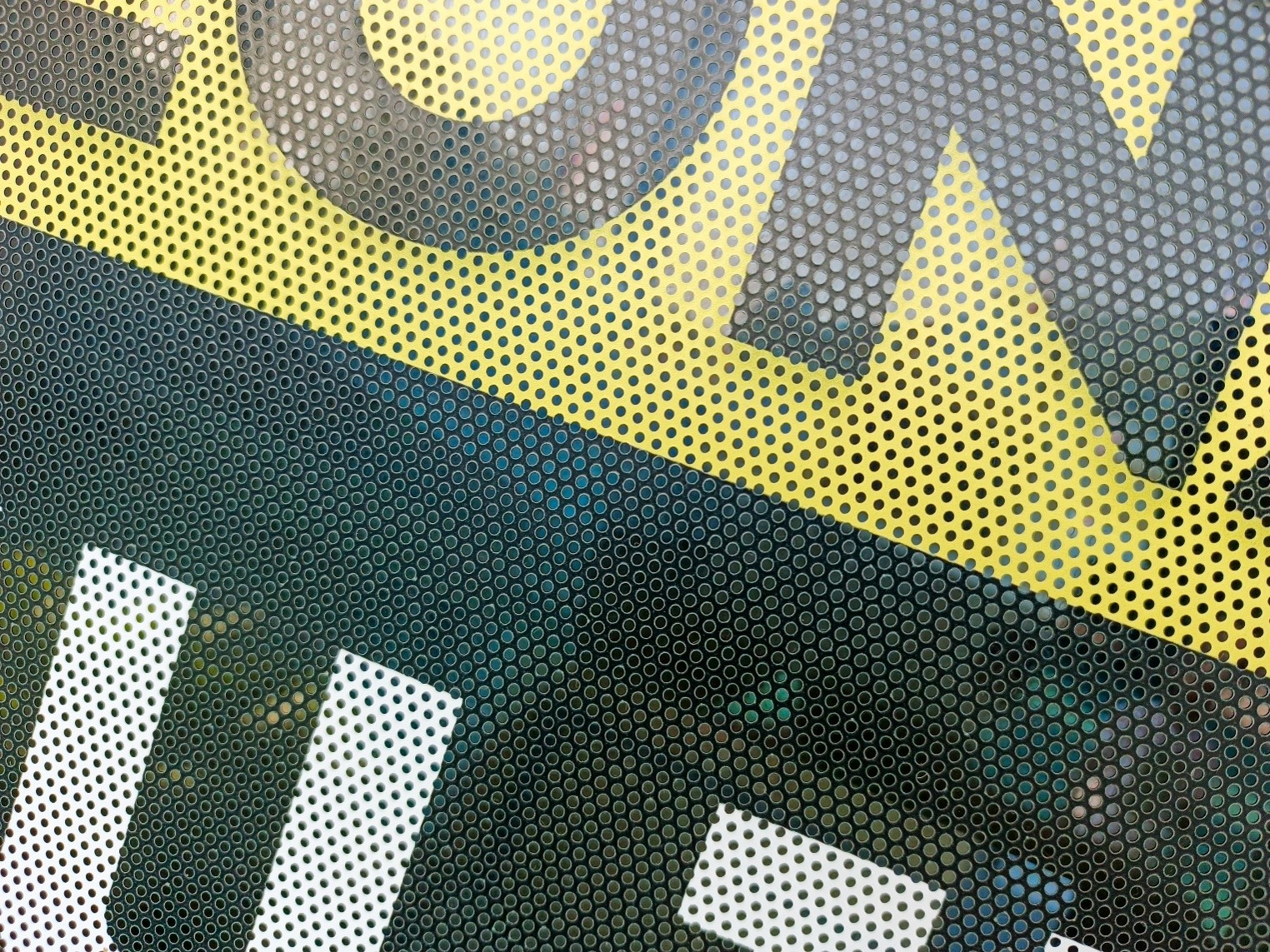
Perforated vinyl — often called one-way vision vinyl or see-through vinyl — is one of the most versatile window graphic materials available. It’s printed on a material with small, evenly spaced holes across the surface: typically a 60/40 ratio of vinyl to open area. From the outside, the surface reads as a solid printed graphic. From the inside, the holes allow visibility through the window, preserving the outward sightline for people inside the space.
This is the material of choice for large window installations where maintaining interior light and visibility matters. A business that wants to cover a significant portion of its front windows with a branded design — without turning the interior into a cave — uses perforated vinyl. It’s also used extensively for vehicle rear windows, where the driver needs to see through the back glass while the exterior presents a full graphic.
Important to know:
perforated vinyl performs best in daylight conditions. At night, when interior lighting is brighter than the exterior, the inside becomes visible through the perforations and the graphic effect is reduced. For businesses that are primarily active during daylight hours, this is rarely an issue. For businesses with significant nighttime activity — restaurants, bars, retail with evening hours — it’s worth understanding before committing to a large perforated installation.
Frosted and etched-look vinyl
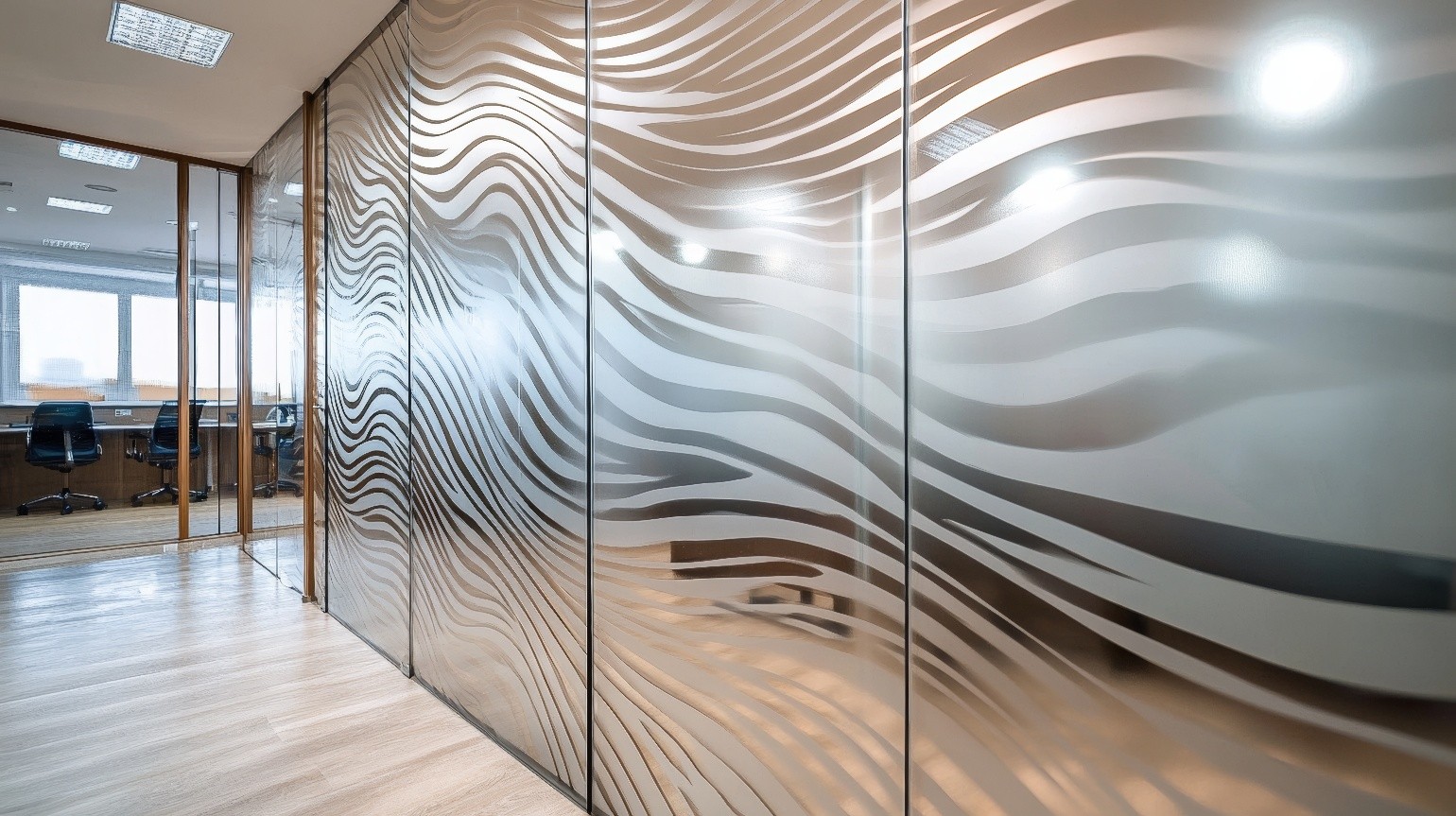
Frosted window film simulates the appearance of etched or sandblasted glass at a fraction of the cost and without any permanent alteration to the glass itself. It’s applied as a translucent film that diffuses light and obscures direct visibility through the treated area while still allowing light to pass through.
The primary applications for frosted vinyl are privacy and aesthetics. Conference rooms, medical and professional offices, reception areas, and any space where visual privacy is needed without blocking light entirely are natural fits. It’s also used decoratively — frosted patterns, logo cutouts, and design elements applied to glass panels create a high-end appearance that reads as etched glass to most viewers.
For businesses in leased spaces, frosted vinyl is particularly valuable: it achieves the look of a significant architectural upgrade with a film that can be removed cleanly when the lease ends, leaving the glass unchanged.
Window perf and full wraps for large glass surfaces
For businesses with large plate glass windows or glass storefronts — car dealerships, large retail, restaurants with significant street frontage — full window treatments using perforated vinyl can transform the entire visible facade of the building. These installations are designed and produced to Grand Format specifications: large-scale, high-resolution, and installed with precision across multiple glass panels.
When done well, a full-facade window treatment creates a level of visual presence that very few other marketing investments can match. The entire front of the building becomes a brand statement that’s visible from a block away in either direction.
Choosing the Right Window Graphic for Your Space
The right choice depends on four questions:
What is the primary goal? If it’s information (hours, phone, services), cut vinyl or simple printed graphics are sufficient. If it’s brand presence or promotions, printed vinyl or perforated material is more appropriate. If it’s privacy, frosted film is the solution.
How much light needs to pass through? Full opaque graphics block interior light. Perforated vinyl reduces light by approximately 40%. Frosted film diffuses rather than blocks. If natural light is important to the interior environment, that constraint shapes the material choice significantly.
Is the installation temporary or long-term? Promotional graphics that change seasonally call for materials designed for shorter lifespans and easier removal. Permanent branding elements should use higher-grade materials designed for five or more years of performance.
What are the lease restrictions? In leased commercial spaces, the lease may restrict what can be applied to the exterior glass. Most window vinyl is removable and leaves no permanent damage, which satisfies most landlord requirements — but it’s worth confirming before ordering.
A Note on Installation
Window graphics look straightforward but are among the most precision-dependent installs in the print world. Bubbles, misalignment, and improper squeegee technique during installation are visible from the street and undermine the professional appearance the graphic is meant to create.
Professional installation by an experienced team — not DIY application from a shipped graphic — is the difference between a window that looks like a design decision and one that looks like a mistake.
Window Graphics in the Mid-Ohio Valley
For businesses in Marietta, Ohio and Parkersburg, West Virginia, window graphics offer a particularly strong return in a market where physical presence and local name recognition carry significant weight in buying decisions. A business that’s visible and professional-looking on the street earns credibility with the local community that digital marketing alone cannot replicate.
Signality Graphics designs, prints, and installs window graphics for businesses across Washington and Wood County. Every installation is produced in-house on our Grand Format equipment, laminated for durability, and installed by our own team. If you’re thinking about updating your storefront or adding window graphics to a new location, we’d welcome the conversation.
We’re at 158 Warner Street, Marietta, Ohio. Give us a visit!