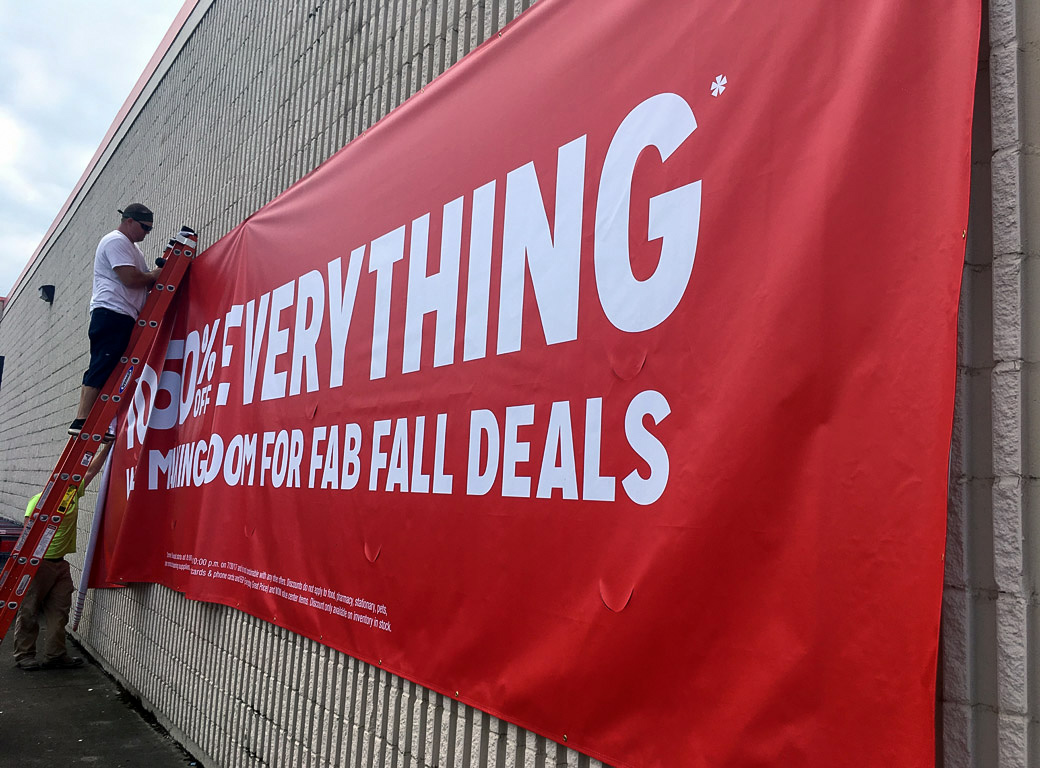
The vinyl banner is the workhorse of business signage. It’s affordable, fast to produce, versatile enough to work indoors or out, and effective for everything from a grand opening to a job site to a trade show. It’s also one of the most commonly ordered — and most commonly under-specified — print products a business will buy.
Not all banners are created equal. The difference between a banner that lasts one season and one that lasts three years often comes down to choices made at the order stage: material, finishing, and how the banner will actually be used. This guide covers what you need to know to order the right banner the first time.
Banner Materials: What You’re Actually Buying
Scrim vinyl — the standard
Most vinyl banners are printed on scrim vinyl, a polyester-reinforced PVC material that’s durable, weather-resistant, and flexible. Scrim refers to the woven mesh layer sandwiched between the vinyl surfaces, which gives the banner its tear resistance and structural strength. It’s measured in ounces per square yard — 13 oz is the common standard, while 15 to 18 oz heavyweight scrim is used for larger banners or longer outdoor lifespans.
Scrim vinyl is the right choice for the majority of banner applications: outdoor advertising, event banners, grand openings, sale announcements, sponsorship banners, and general business signage. It prints with vivid color, holds up to weather, and lasts multiple seasons when properly cared for.
Mesh banner vinyl — for wind
Mesh banner vinyl is perforated with small holes across its surface, allowing wind to pass through rather than catching it like a sail. This makes it the correct choice for any large outdoor banner exposed to wind — building wraps, construction fence wraps, stadium and field perimeter banners, and any installation on fencing or scaffolding.
The tradeoff is that the perforations slightly reduce color saturation, so mesh is best for bold graphics and large text rather than fine detail or photographic images. For any large outdoor banner where wind is a factor, though, mesh isn’t just preferable — it’s often the only safe option.
Smooth and specialty vinyls
For premium indoor applications — backdrops, step-and-repeat banners for events, photo walls — smooth (non-scrim) vinyl and specialty finishes like matte or fabric-look materials produce a higher-end appearance without the texture of standard scrim. These are worth the upgrade when the banner will be photographed or displayed in a controlled, close-viewing environment.
Finishing Options: The Details That Matter
How a banner is finished determines how it installs, how long it lasts, and how well it survives handling. The standard finishing options:
- Hemming — Hemmed edges — the banner edges are folded and welded or sewn for reinforcement. Standard on quality banners; prevents fraying and tearing.
- Grommets — Grommets — metal rings set into the edges at intervals for hanging with rope, zip ties, or hooks. The most common hanging method.
- Pole pockets — Pole pockets — sewn sleeves at the top and/or bottom for a pole or bar to slide through. Used for hanging banners and boulevard/street-pole banners.
- Wind slits — Wind slits — cut openings that let wind pass through. An option for solid vinyl banners in moderate wind, though mesh is better for high-wind locations.
- Corners — Reinforced corners — extra material at stress points where the banner attaches. Worth adding for large or long-term outdoor banners.
The right finishing depends entirely on how the banner will be hung and where. A banner zip-tied to a chain-link fence needs grommets; a banner hung from a storefront awning might need pole pockets; an outdoor banner in an exposed location needs hemming, reinforced corners, and possibly wind mitigation. Specifying finishing correctly at the order stage prevents a banner that can’t be installed the way you need it.
Sizing and Design Considerations
Readability at distance
The single most common banner design mistake is text that’s too small to read at the distance the banner will be viewed from. A banner across a storefront read by drivers needs much larger text than a banner behind a registration table read from a few feet away. As a rough guide, every 10 feet of viewing distance requires about one inch of letter height for comfortable reading — so a banner meant to be read from 100 feet away needs letters roughly 10 inches tall.
Less is more
A banner is not a brochure. The most effective banners communicate one clear message, a visual, and a single call to action or piece of contact information. Cramming a banner full of text, multiple messages, and fine print defeats the purpose — a passerby has seconds to absorb it. Decide the one thing the banner needs to accomplish and design around that.
Standard vs. custom sizes
Banners can be printed to virtually any size. Common standard sizes (2×4, 3×6, 4×8 feet) are economical and suitable for most uses, but custom dimensions are readily available when a specific space calls for them — a banner sized to fit a particular wall, fence run, or storefront. With Grand Format equipment, large single-piece banners can be produced seamlessly without panel seams.
Indoor vs. Outdoor: Matching the Banner to the Job
For outdoor use: scrim or mesh vinyl, UV-stable inks, hemmed edges, grommets or pole pockets, and reinforced corners for anything large or long-term. The banner needs to survive sun, wind, and rain.
For indoor use: the durability requirements relax, which opens up smooth vinyl and premium finishes. Indoor banners can prioritize appearance over weather resistance — important for trade show displays, event backdrops, and retail signage that will be seen up close.
Banner care extends lifespan
Outdoor banners last longer when taken down and stored during extreme weather when practical, cleaned occasionally with mild soap and water, and rolled rather than folded for storage (folding creates permanent creases). A quality scrim banner properly cared for can last three or more years outdoors.
Getting Banners Made Locally
Banners are often needed on short timelines — an event announced, a sale scheduled, a grand opening dated. Local, in-house production means a banner can be designed, printed, and finished in days rather than the week-plus turnaround of an online order shipped from a distant facility. For a business that needs a banner this week, that difference matters.
Signality Graphics produces custom vinyl banners in-house on Grand Format equipment — scrim, mesh, and specialty materials, with full finishing options, in standard and custom sizes. Whether it’s a single banner or a recurring need, we can produce it quickly and correctly.
Call 740.371.5100 or visit us any time. We’re at 158 Warner Street, Marietta, Ohio.