
Compliance signage is one of those responsibilities that’s easy to overlook until an inspection, an audit, or an incident makes it urgent. For facility managers, safety directors, and business owners, getting it right isn’t optional — ADA and OSHA signage requirements are enforceable, and the penalties for getting them wrong range from fines to liability exposure.
The good news is that compliance signage is well-defined. The standards exist, they’re specific, and a sign shop that understands them can produce signage that meets requirements without guesswork. This guide explains what’s required, why the details matter, and how to approach a compliance signage project.
ADA Signage: The Basics
The Americans with Disabilities Act sets requirements for signage in public accommodations and commercial facilities. The goal is to ensure that people with disabilities — particularly those with visual impairments — can navigate and use a facility independently. ADA signage requirements apply to a wide range of businesses, and they’re among the most commonly cited issues in accessibility complaints.
Which signs need to be ADA-compliant?
Not every sign in a building is subject to ADA requirements. The rules apply specifically to signs that identify permanent rooms and spaces, provide direction to or information about functional spaces, and identify accessible features. In practice, that means:
- Permanent room identification — restrooms, exits, stairwells, room numbers, and named spaces that don’t change function
- Directional and informational signs — wayfinding to accessible entrances, elevators, and facilities
- Accessibility identifiers — signage marking accessible parking, entrances, and routes
Signs that are purely directories, temporary notices, or company branding without a room-identification function generally fall outside the strict ADA technical requirements — though good design practice still favors accessibility throughout.
ADA technical requirements
ADA-compliant room identification signage has specific technical requirements that a general sign isn’t built to meet:
- Tactile characters — raised letters and numbers, minimum 1/32 inch above the surface
- Braille — Grade 2 Braille positioned directly below the corresponding text
- Character requirements — sans-serif fonts, specific height ranges, and non-glare finishes
- Contrast — at least 70% light reflectance contrast between characters and background
- Mounting — installed at a specified height (typically 48 to 60 inches to the baseline of the tactile characters) and on the latch side of doors
These requirements are why ADA signs are produced differently than standard signage. The tactile and Braille elements require specific manufacturing processes, and the contrast and finish requirements dictate material choices. A shop that produces ADA signage regularly builds these requirements in as a matter of course.
A Note on Liability
ADA non-compliance is a common basis for accessibility complaints and lawsuits, many of which target small and mid-sized businesses. Properly produced ADA signage is inexpensive relative to the cost of a complaint — and it’s the right thing to do for the people who rely on it.
OSHA Safety Signage: The Basics
Where ADA signage is about accessibility, OSHA signage is about safety. The Occupational Safety and Health Administration requires specific signage to warn of hazards, communicate safety information, and direct behavior in workplaces — particularly industrial, manufacturing, construction, and warehouse environments.
OSHA adopted the ANSI Z535 standard as the framework for safety sign design. The standard defines a system of signal words, colors, and formats that communicate the severity and nature of a hazard at a glance — which matters, because in a real workplace hazard, a worker needs to understand the warning instantly.
The ANSI Z535 signal word system
Every OSHA-compliant safety sign uses a defined signal word and color combination based on the severity of the hazard:
- DANGER — DANGER — red header, white text. Immediate hazards that will cause death or serious injury if not avoided.
- WARNING — WARNING — orange header, black text. Hazards that could cause death or serious injury.
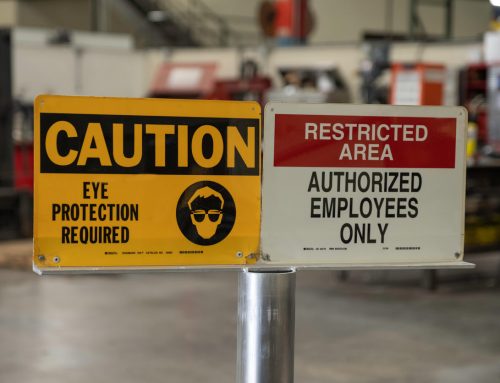
- CAUTION — CAUTION — yellow header, black text. Hazards that could cause minor or moderate injury.
- NOTICE — NOTICE — blue header, white text. Information important but not directly safety-related.
- SAFETY — SAFETY INSTRUCTIONS — green header, white text. General safety information, first aid, and safety equipment locations.
Using the wrong signal word or color for the severity of the hazard isn’t a cosmetic error — it undermines the entire system. A hazard that warrants a DANGER sign but carries only a CAUTION label understates the risk, and that can constitute a compliance violation as well as a genuine safety problem.
Common OSHA signage categories
Facilities typically need safety signage across several categories: hazard warnings (electrical, chemical, mechanical), personal protective equipment requirements (hard hat, eye protection, hearing protection zones), emergency and exit information, equipment-specific warnings, and confined space or restricted area identification. A facility safety audit will identify which categories apply to a given operation.
Material and Durability Considerations
Compliance signage has to remain legible and intact for the life of the installation. A faded, peeling, or damaged safety sign is effectively a non-compliant sign. Material selection depends on the environment:
- Interior office and facility signage — rigid substrates with non-glare finishes for ADA compliance
- Industrial and warehouse environments — durable substrates resistant to abrasion, chemicals, washdown, and temperature variations
- Outdoor and exposed locations — UV-stable materials and laminates that resist fading and weathering
- High-contact areas — materials that tolerate cleaning and handling without degrading
For facilities in industrial settings — a significant part of the business landscape in the Mid-Ohio Valley — the durability requirements are real. Signage in a manufacturing or processing environment faces conditions that consumer-grade materials won’t survive.
How to Approach a Compliance Signage Project
For a facility manager taking on compliance signage, a structured approach prevents gaps:
- Audit the facility — walk the space and identify every location that requires ADA or OSHA signage. Document what exists and what’s missing or non-compliant.
- Categorize by standard — separate ADA room/wayfinding signage from OSHA hazard signage, since they follow different rules.
- Specify correctly — work with a sign shop that understands the technical requirements and can produce to spec, rather than adapting generic signage.
- Plan for consistency — a facility’s signage should be visually consistent across the building, which is easier when it’s all produced by one shop in one project.
- Document the installation — keep a record of what was installed where, which supports future audits and inspections.
Signality Graphics produces compliance signage in-house
We produce ADA-compliant tactile and Braille signage and OSHA/ANSI-compliant safety signage for facilities throughout Washington and Wood County. Everything is made in-house to the correct technical specifications.
If you’re facing an audit, opening a new facility, or updating outdated signage, we can help you get it right. Call 740.371.5100 or visit signalitygraphics.com. We’re at 158 Warner Street, Marietta, Ohio.
The Bottom Line
Compliance signage isn’t the most glamorous part of running a facility, but it’s among the most consequential. ADA and OSHA requirements exist to protect people, and they’re enforceable. Getting compliance signage produced correctly — to the right technical standards, in durable materials, consistently across a facility — is a manageable project with the right partner, and it removes a real source of liability and risk.